
Why do AI and Document Processing Companies Love the ACORD 25?
By

Hoch Cho
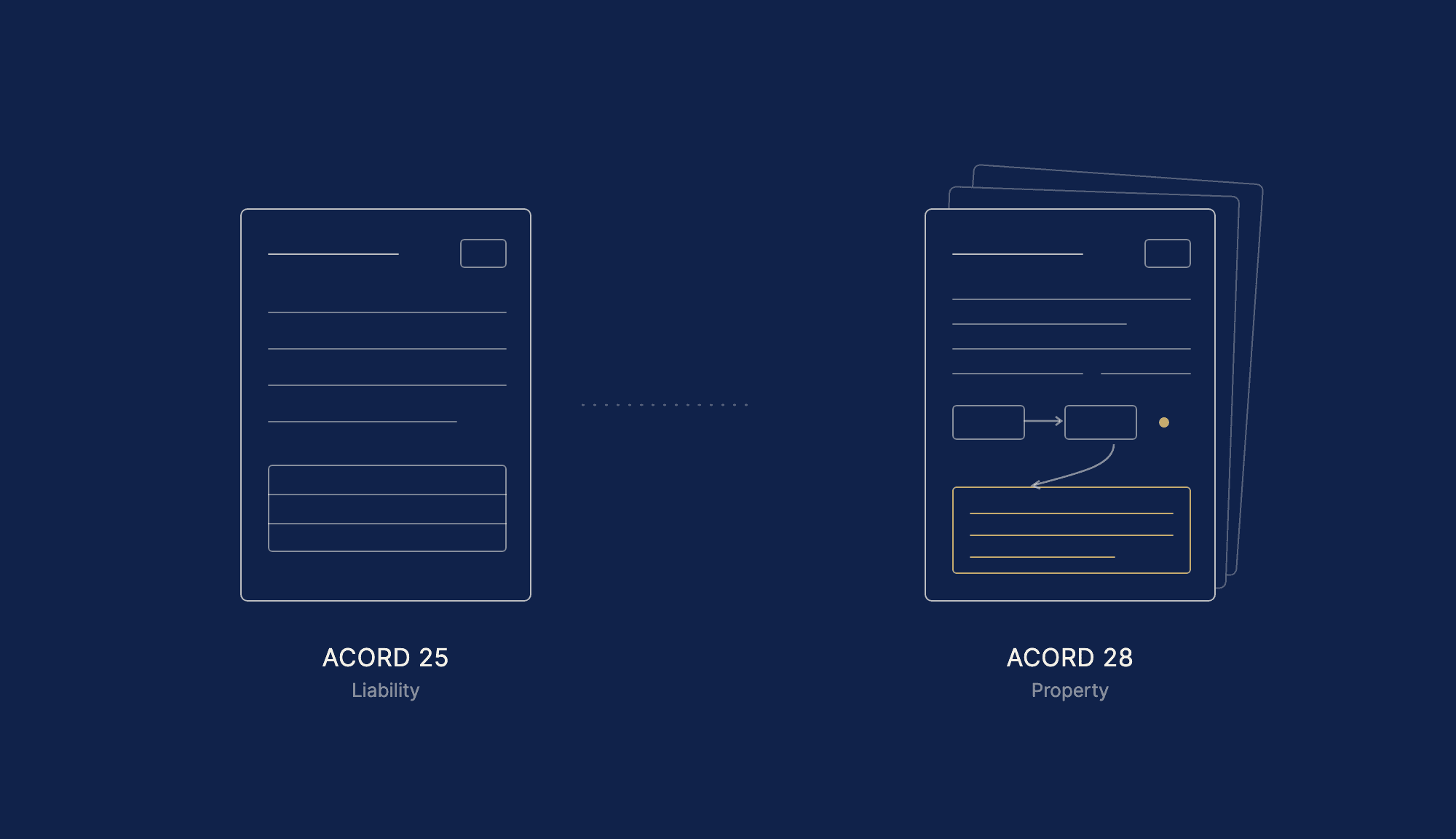
Have you ever wondered why all case studies & blogs on commercial property insurance compliance feature the ACORD 25, but never the 28? Anyone who reads these things for a living knows why. While the ACORD 25 is no picnic to analyze, it pales in comparison to the complexity of the ACORD 28. The ACORD 25 lists liability coverage while the ACORD 28 lists property coverage. Both are required to be compliant.*
The following table summarizes why property is so much harder than liability.
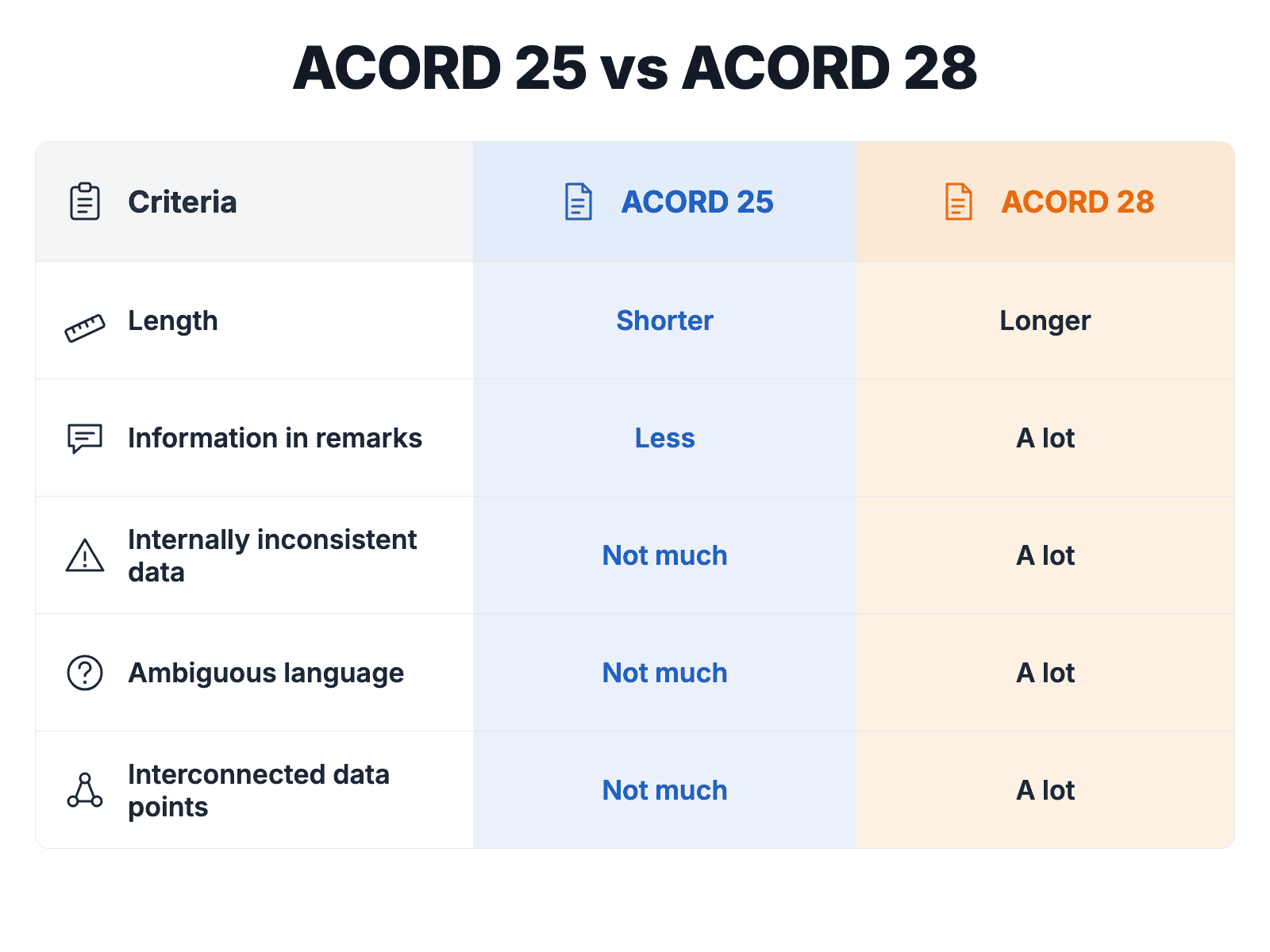
The ACORD 28 tends to have more pages and thus has more information in the remarks section. The remarks are either created free-hand or copy-pasted piecemeal from other documents. Thus, like all free-form language, it can be inconsistent or ambiguous.
What makes it even more difficult is that inconsistency and ambiguity are key features of the 28. For example, the Coverage Limit for a category could be a minimum of four different numbers from different areas in the document. It’s one amount if it’s Blanket, another if it’s blanketed by location, another if it’s a particular coverage, or even another if the building is in a certain county, state, zone, type of earthquake construction … It is a rock, scissors, paper scenario but with dozens of different possibilities.
If the language is ambiguous, we have found that different servicers interpret the language differently. Each servicer has an established relationship with their borrowers and their insurance agents, and over the years have developed an understanding of how to convey information. While it may read as ambiguous to a third party without context, it is crystal clear to our customer.
Finally, data items in the ACORD 28 can be connected. A box in the form part may point to another box which points to a phrase in the Remarks. Unraveling all that to get to an answer isn’t hard, but it is tedious.
Everyone always laments the complexity of these documents and wonders why the industry can’t create a standardized digital way of exchanging this information. It’s hard because these documents are a fossil record of all the ways a property owner and a carrier can lose money. Any unforeseen item that leads to a loss gets crystallized as a new term entered into the Remarks. The world has been more inventive in finding new ways to destroy property (terrorism, hurricanes, wildfires) than to create liability. In addition, the capital & ownership structure of real estate increasingly gets more complex. The fossil record is not only complicated, but it just keeps evolving.
The next time you get a report stating a property is compliant from an ACORD perspective, know that 80% of the effort probably went to the ACORD 28. The next time someone wants to give a demo, probably a good idea to ask for the 28 first.
We salute the ACORD 28. It is an honored adversary. We have read thousands of you. May you, with your quirks, deceptively simple tables & stilted language, continue to provide peace of mind to lenders and investors everywhere.
The first step on the path to insurance compliance is analyzing the ACORD 25 and 28. These are Certificates of Insurance issued by an Agent to “show” that there are policies insuring the property. We put “show” in quotes because an ACORD is not a legally binding document, simply a summary of terms.
*While ACORDs are not legally binding (a full Policy is required), they are a shorthand way of knowing what coverages exist. They have no basis in law. Why are they tracked at all? This is a longer story which will be answered in another post.
See more articles

Resources
A tool to help you experiment with AI
Data privacy keeps most servicers from experimenting with AI on documents. Here’s a safe way to try it in your own cloud.
By
Hoch Cho

CRE Inspections
The MBA Inspection Form Update Is Old News. The Enforcement Isn’t.
Property inspection reporting for commercial and multifamily loans changed in 2025.
By
Jon Falker

Copyright © 2026 | Firehorse Group LLC